Objects of Enduring Memory: Five Heirloom Pieces That Became the Soul of American Family Legacies
An heirloom is not simply an old object. It is an object that has been chosen — consciously or otherwise — to carry a family's story forward. The choosing happens quietly, often without ceremony: a brooch worn at every significant gathering until its absence would constitute a kind of grief; a strand of pearls passed from mother to daughter with the gravity of a spoken promise; a wristwatch wound faithfully for fifty years and then placed, still ticking, into a grandchild's palm.
The pieces profiled here belong to families who have graciously allowed Pink Cleef to document their provenance. In each case, what began as an extraordinary object became something far more complex — a vessel for memory, a marker of identity, and a quiet argument for the permanence of beautiful things.
I. The Newport Sapphire Parure, circa 1908
The Aldrich family of Rhode Island has never been particularly interested in discussing their wealth. What they will discuss, with evident warmth, is the sapphire parure that has appeared in nearly every significant family portrait since the Edwardian era.
Commissioned by Eleanor Aldrich as a wedding gift to herself — a then-radical act of feminine self-determination that her descendants cite with obvious pride — the suite consists of a necklace, two bracelets, and a pair of ear pendants set with Burmese sapphires of an uncommon cornflower blue. The stones, sourced through a New York importer with longstanding connections to the Mogok Valley, were selected individually over the course of a year.
What makes the parure remarkable today is not merely its gemological distinction, though a contemporary appraisal would place its value well into seven figures. It is the evidence of continuous wear across five generations — the slight softening of the gold settings, the particular patina that no restoration has ever been permitted to disturb. "My grandmother always said that polishing it would be like editing her mother's handwriting," notes the current custodian, Eleanor's great-great-granddaughter. "The wear is the history."
II. The Mainbocher Evening Coat, 1953
When the American designer Mainbocher dressed Margaret Hartwell of Chicago for her daughter's coming-out ball in the autumn of 1953, he could not have known he was creating the garment that would define a family's aesthetic vocabulary for the next seven decades.
The coat — ivory silk faille, floor-length, with a standing collar and a single closure of hand-carved bone — has been worn by four generations of Hartwell women at moments of formal significance. Margaret wore it to the ball. Her daughter wore it to her own engagement announcement. The third generation wore it, altered slightly at the hem, to a White House state dinner in 1987.
Currently held in archival storage in the family's Lake Forest home, the coat has been exhibited twice — once at the Chicago History Museum, once at a retrospective of Mainbocher's work in New York. On both occasions, it was returned to the family within a week. "It doesn't belong in a case," says the current generation's eldest daughter. "It belongs to us. That is the entire point."
III. The Texas Emerald Ring, 1965
Some heirlooms arrive through inheritance. Others are earned. The Delacroix emerald ring — a Colombian stone of approximately seven carats, set in yellow gold with flanking diamonds by a Houston jeweler now long closed — was purchased by oil wildcatter James Delacroix on the day his company first turned a profit, after eleven years of effort.
He placed it on his wife Dorothy's finger at their kitchen table, not at a restaurant or a celebration. That detail has been repeated in the family ever since, passed down with the same fidelity as the ring itself. "He didn't want witnesses," Dorothy told her children. "He wanted it to be ours."
The ring has since passed to the Delacroixs' son, who has no daughters of his own, and has quietly decided that it will go to whichever of his children — son or daughter — demonstrates the most genuine appreciation for what it represents. He has never specified what that demonstration might look like. He trusts, he says, that he will recognize it.
IV. The Cartier Tank, 1947
The provenance of the Nakamura family's Cartier Tank watch reads like a compressed history of twentieth-century American ambition. Acquired in 1947 by Kenji Nakamura, a Japanese-American businessman who had rebuilt his San Francisco import company from nothing following the internment years, the watch was chosen specifically because it was French — a deliberate gesture toward a world that had, in his view, treated him more fairly than his own country had.
The Tank has been worn by three Nakamura men in succession, each of whom has had it serviced exactly once. It keeps near-perfect time. More significantly, it keeps near-perfect faith — with Kenji's memory, with the family's history of perseverance, and with the principle that quality endures when everything else is stripped away.
"When I wear it, I think about what he had to rebuild," says the current custodian, Kenji's grandson. "A watch that still runs after seventy-five years is a statement about what lasts. He understood that before I was born."
V. The Boston Pearl Rope, Undated
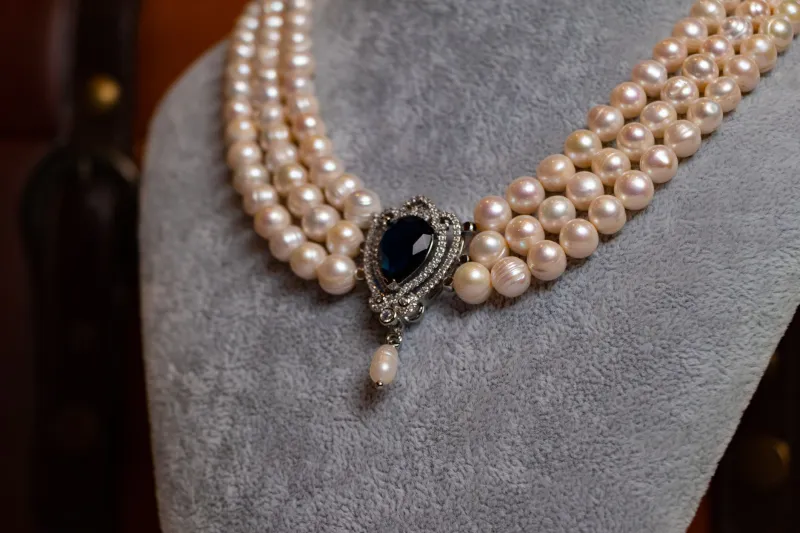
No one in the Cabot family of Massachusetts knows precisely when the pearl rope entered their possession. Family lore places it somewhere in the 1880s; a gemologist consulted in 1994 suggested the pearls themselves may be older still. What is known is that it has appeared in family photographs continuously since the earliest available images, worn by women of every generation at occasions ranging from weddings to funerals to, in one memorable instance, a sailboat race off Marblehead.
The rope — 108 inches of natural pearls, knotted by hand between each stone — has never been restrung. The silk cord has been replaced three times, each time by the same Boston jeweler across three generations of that family as well. It is, in this sense, a collaboration between two families, a shared stewardship of something that belongs, in some fundamental way, to neither.
"Heirlooms are not owned," says the current Cabot custodian. "They are borrowed, with the understanding that you will return them in better condition than you received them — not physically better, necessarily, but richer. More full of meaning. That is the obligation."
It is an obligation, Pink Cleef would suggest, that the truly discerning collector understands instinctively — and honors without being asked.