The Hand Behind the Heirloom: Why Knowing Your Maker Has Become the Ultimate Luxury
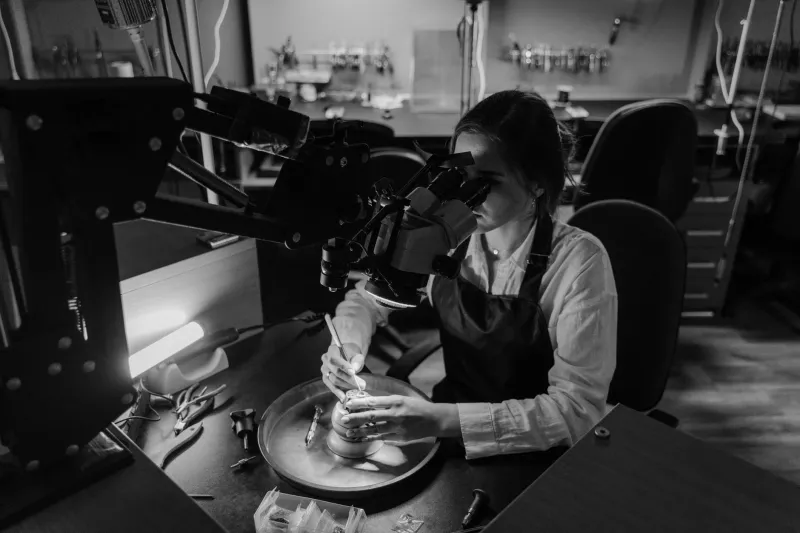
There is a particular kind of confidence that belongs to the person who can speak, without hesitation, about the goldsmith who set the stone in their ring. Not the maison, not the collection name—but the individual, the craftsperson, the human being who spent the better part of a career learning to coax precious metal into something that defies easy description. In America's most thoughtful luxury circles, this knowledge has become the new marker of genuine sophistication.
It is a shift that has been building quietly for some time, but in recent years it has crystallized into something unmistakable. The collector who once sought out the most recognizable name on the box is now seeking out the least familiar—because unfamiliarity, in this context, signals discovery. It signals a relationship forged through research, through travel, through the willingness to sit across a workbench and understand.
From Brand Worship to Biographical Depth
For much of the twentieth century, American luxury culture organized itself around institutional authority. The great European houses offered a kind of inherited prestige—one purchased not merely an object but membership in a lineage of taste. That framework served its purpose, and the finest houses earned their reputations honestly. But something has shifted in the cultural atmosphere.
Today's most discerning consumers—those who have moved beyond the first or second act of acquisition—find themselves hungry for something the institutional model cannot easily provide: specificity. They want to know that a particular ring was shaped by hands that have been shaping rings since before the internet existed. They want to understand the particular school of thought that informed a tailor's approach to a shoulder seam. They want provenance that is human, not merely historical.
This is not nostalgia. It is a more demanding form of connoisseurship.
The Artisan as Narrator
What the master craftsperson offers, above all else, is a story that cannot be replicated by a factory or franchised across a global retail network. A bespoke jeweler in the Hudson Valley who trained under a Florentine goldsmith carries within her practice a living thread of knowledge—one that connects her clients, however indirectly, to centuries of accumulated technique. A shirtmaker in Charleston who cuts every collar by hand according to proportions he has spent decades refining is offering something categorically different from even the most expensive ready-to-wear.
The story, in these cases, is not a marketing device. It is the object itself, rendered in biographical terms.
This is why direct relationships with independent artisans have come to represent a kind of luxury that no amount of money can simply purchase off a shelf. The waiting list for a particular maker's work is not an inconvenience—it is evidence of scarcity that is genuinely earned, rooted in the limits of human time and attention rather than in artificial constraint.
Transparency as Aesthetic Value
There is an aesthetic dimension to this transparency that is easy to overlook. When you understand the philosophy behind a piece—the specific choices made, the techniques employed, the problems solved—you perceive the object differently. The eye is educated. A hand-engraved surface reads not merely as decoration but as the record of a decision made in real time, at a particular moment, by a person with particular convictions.
This educated perception is, in itself, a form of elegance. It is what separates the collector from the consumer. And it is what allows a relatively modest piece, made by a skilled independent artisan, to carry more genuine weight in a curated wardrobe or jewelry collection than a far more expensive object whose origins remain opaque.
American collectors are discovering this with increasing frequency. The jeweler whose workshop can be visited, whose process can be witnessed, whose philosophy can be discussed over an afternoon—this person offers something the flagship boutique on Fifth Avenue structurally cannot.
Building a Vocabulary of Makers
For those who wish to orient their collecting around this principle, the practice begins with curiosity rather than budget. It begins with asking questions that most luxury retail environments are not designed to answer: Who made this? Where did they train? What distinguishes their approach from another craftsperson working in the same tradition?
The answers, when they come, form the beginning of a personal vocabulary—a set of names and relationships that define a collection as surely as any aesthetic theme. Over time, this vocabulary deepens. One maker leads to another. A conversation with a silversmith reveals an admiration for a particular textile artist. A bespoke tailor recommends a shoemaker who shares his commitment to a specific philosophy of fit.
This is how the most meaningful collections are assembled: not through a single decisive act of purchase, but through the slow accumulation of relationships that are, at their core, intellectual and human.
The Status That Cannot Be Borrowed
What makes artisan knowledge so compelling as a marker of refined taste is precisely that it resists imitation. One can acquire the appearance of luxury through any number of routes. But the ability to speak knowledgeably about the person who made your cufflinks—to describe their training, their materials, their particular contribution to a craft tradition—is not available for purchase. It must be earned through attention.
In a cultural moment saturated with the performance of sophistication, genuine knowledge stands apart. The whisper of true craftsmanship is, in the end, the loudest thing in the room.